This Honeyguide blog is a copy of a short paper that was published in The Norfolk Natterjack, quarterly bulletin of the Norfolk & Norwich Naturalists' Society. It seems apt to include it here as two of the new findings were on local (Norfolk) Honeyguide events, and previously reported on the Honeyguide blog (see links in the blog). The paper as published is here: Natterjack 156, February 2022, pp3-5; it followed up this article about the third record of this species in England and second in Norfolk. The paper and this blog follows NNNS house style, with capital letters for species.
Three more records of Hoof Fungus gnats
Inspired by the
account of Hoof Fungus Fomes fomentarius in Norfolk’s Wonderful 150 and
knowing that the Norfolk & Norwich Naturalists’ Society is studying the new
Broadland Country Park, when I found Hoof Fungus in the country park I emailed Tony
Leech to check that it was known from there. I also mentioned that Sarah
Burston, the park’s manager, had told me about a rare fungus gnat recently
found there. It was no surprise to learn from Tony that Hoof Fungus was already
known from Broadland CP, and he also kindly sent me his text and Milly
Kenward’s photo of Sciophila rufa cocoons that later appeared in the
November 2021 Natterjack, noted there as the second record for Norfolk
and the third for England.  |
| Three Hoof Fungi on a Silver Birch, including one with several cocoons of Sciophila rufa. Broadland Country Park, 23 September 2021. |
Armed with this
pre-publication reference, I returned to Broadland Country Park on 23
September, leading a small group from Honeyguide
Wildlife Holidays (blog here). We found Hoof Fungi on three standing stumps of birches Betula
and on one of these, with about 30 ‘hooves’ showing, we quickly found the
distinctive fungus gnat cocoons shown in Milly’s photo. It may be worth adding
that there is both Silver Birch B. pendula and Downy Birch B. pubescens
in the country park and the Hoof Fungi were all on Silver Birches.
On 5 November 2021 (blog here), I was at Foxley
Wood Norfolk Wildlife Trust nature reserve, again with a small Honeyguide group.
I re-found a Silver Birch stump with Fomes that I remembered from a
previous visit and, hey presto, there were identical cocoons. Could these be
the third record of S. rufa for Norfolk and the fourth for
England?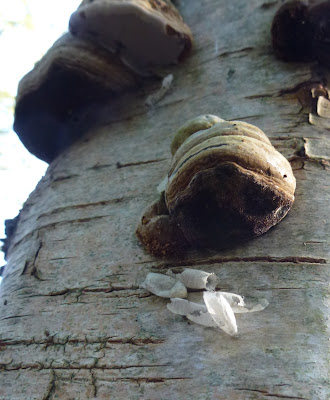 |
| Sciophila rufa cocoons on Hoof Fungus, Foxley Wood, November 2021 / Chris Durdin |
On 17
November, I returned to Broadland Country Park (blog here), this time with different
Honeyguiders. We found more S.
rufa cocoons and they
were certainly on a different birch. Not only was it
in a different place in the wood, this stump was long-fallen, not standing.
 |
| Hoof Fungi on a fallen birch, Broadland Country Park, 17 November 2021. On the left fungus, which is clearly layered, the bottom layer is the youngest; hoof fungi can live for up to 30 years. Top right includes a fungus gnat cocoon. |
Finally, walking
on Mousehold Heath, Norwich, on 28 November 2021 with my wife Julie, I returned
to where I’d previously seen Hoof Fungi, close to Zaks Mousehold Diner. There
were no cocoons by the fungi on the standing stump, though when I examined a
fallen stump at the same spot there was a single cocoon under the overhang of a
Hoof Fungus.
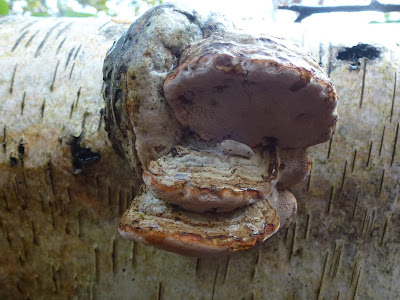 |
| Hoof Fungus, Mousehold Heath, on a fallen birch, with a single S. rufa cocoon. The fungus growth’s change of direction shows that the stump fell off the main trunk several years ago. / Chris Durdin |
.jpg) |
| Birch with Hoof Fungus, Mousehold Heath, Norwich. The red arrow marks the dead standing stump with Hoof Fungus; the blue arrow is the location of the fallen part of, presumably, the same stump, where the Hoof Fungus growing in two directions, with a S. rufa cocoon, was photographed. |
Given that S.
rufa cocoons are distinctive once you’ve seen a photo, I wondered if they
had been found several times in Norfolk once the Natterjack article had
appeared. Not so, says Tony Irwin, at least from his inbox. I contacted
national fungus gnat expert Peter Chandler, who confirmed the IDs, noting that:
“There are similar species on other fungi but it's
only likely to be S. rufa on Fomes.”
From the above
and Peter Chandler’s information we have the following sequence of records for S.
rufa in England.
1/ 23 September 2017, Flitwick Moor,
Bedfordshire.
2/ 19 May 2019, between Stow Bedon and
Thompson Common, Norfolk.
3/ 12 September
2021, Broadland Country Park, Norfolk.
4/ 5 November 2021, Foxley Wood, Norfolk.
5/ 17 November
2021, Broadland Country Park, Norfolk.
6/ 28 November
2021, Mousehold Heath, Norfolk.
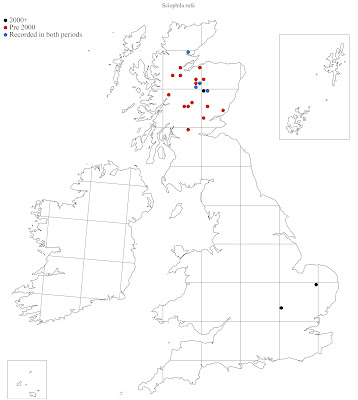 |
| Sciophila rufa 2020 distribution map, before these 2021 Norfolk records / Peter Chandler |
My various photos show that the cocoons can be above, to the side of or below Hoof Fungi, sometimes touching, sometimes not, and on occasions a few centimetres from the fungus. They are usually by paler, younger Fomes, or at least Fomes showing recent growth, and are evidently comfortable close to the ground. It’s also interesting to see how long the cocoons survive into the autumn. At Mousehold Heath, I had the impression that the cocoon had survived autumn rain and wind by being protected by the natural overhang of a Hoof Fungus.
I suggest that for anyone who has photos of Hoof Fungus, it
could be worth checking them and more records of S.
rufa may well come to light.
In any event, as Peter Chandler observes of S. rufa: “It seems
that it is now well established in Norfolk.”
The next challenge is to return from
May onwards and look for the larval webs, larvae or orange-coloured adult
fungus gnats.
References:
Leech, T, 2021. A
chance observation and a third English record. The Norfolk Natterjack, November
2021.
Webb, Judy, 2019.
A second English record of Sciophila rufa. Dipterists Digest 2019, Vol
26, no 1.


.jpg)