Friday, 17 February 2023

Brecks guided walk, 16 February 2023

Talk as we travelled was about the weather, but happily the drizzle petered out and wasn’t a nuisance, though it remained grey all day. 

There was lots of bird song at the Forestry Commission’s car park at Santon Downham – we heard song thrushes and robins for much of the day, plus coal tit here. We crossed the bridge over the river Little Ouse, returning to Norfolk by doing so; nearby there was a nuthatch on a tree top. On the river were mute swans, mallards and moorhen, and two little grebes became three, then four.

Little Ouse. We liked the sculpture-like upturned branches in the river.
An old tree stump had many large plates of southern bracket. Other fungi today included turkeytail, an old oyster fungus of some type and three hoof fungi on a tall birch stump.

Southern bracket and digiscoped hoof fungus.
Everywhere there was dead wood: stumps, fallen trees – including some in or over the river – and a lot of standing dead wood. Cheryl found a treecreeper, though it was no surprise that we didn’t see or hear the lesser spotted woodpeckers known from here: typically they show on a bright late winter’s day. The only woodpecker was a distant drumming, out of sight, which was probably a great spotted woodpecker. We found some tree top siskins, one twisting its tail making it seem like a bigger bird then we’d expect.

Ann has trained us well, and many of us found cigar galls on reeds.

Parsley piert.
We took a return route along the edge of a reedbed, under the railway and onto the heath. A sandy, disturbed patch here had emerging leaves of parsley piert, easy to overlook even when in flower, which this wasn’t. We then overlooked the heath on the other side of road where a mistle thrush on the ground flew to a bare tree and soon there were four, with some jostling going on within the mistle thrush hierarchy. Our first buzzard of the day appeared. Ann and went to look at a stump that was covered with fungi. From the top they looked like turkeytail but the gills on the underside meant a rethink: oak mazegill.

Oak mazegill.
We enjoyed the sight of highland cattle and, in a rushy field, a pair of stonechats.

Stonechat, male, digiscoped.
We had our picnics in the car park and it was dry enough for four of us to share a bench. From here there were glimpses of stock dove and woodpigeon display flights, plus collared doves.

We drove to Lynford Arboretum for the rest of the afternoon. We paused where the Forestry Commission puts out food. For moment it seemed like it was mostly blue and great tits feeding, though soon yellowhammers appeared.

Yellowhammer, digiscoped in the gloom. Still, you can see what it is.
Farther on, over the river, we scanned the row of trees known to attract hawfinches. Instead, the main attraction here was redwings, perching mostly high in the trees. A great spotted woodpecker joined them.

Joining other birdwatchers a little farther along, one of them was alert to small birds arriving to perch high on distant conifers: hawfinches. There were four – two and two – that stayed for a good while. They were distant, though their distinctive profile was clear through telescopes.

Possibly the worst photo ever included in a blog: very distant, digiscoped hawfinches on a gloomy day.

Retuning towards the bridge, several small birds were moving around the empty bird feeders here, including a marsh tit that landed on one of the low pillars on the bridge. At the feeders the yellowhammers were there again, and a siskin came to drink.

Through this guided walk, and the previous week's walk at Hickling, Honeyguide donated £175 to Norfolk Wildlife Trust.

Chris Durdin

Thursday, 9 February 2023

Hickling guided walk, 9 February 2023

Though cold in the wind at times, mostly it was as sunny and bright as you could ever wish for on a winter’s day. A chaffinch was singing in the car park before eight of us checked in at NWT’s visitor centre; we were soon off on an anti-clockwise circuit of the nature reserve.

With Ann and so many reeds inevitably we soon found her speciality: cigar galls. Ann has trained us well and several of us were finding them; there must have been dozens. There was nothing to see from the first hide bar a distant harrier – there were plenty more later - so we walked on. Parts of the reedbed had been cut, cleared and burnt very recently, the usual round of winter management and habitat maintenance. The next stretch of the reserve yielded several birch polypores and the clear, metallic ‘ping’ of a calling bearded tit, though it stayed out of sight.

Cigar galls on reed.
Overlooking Hickling Broad the expected mute swan flock was well spread out. There were cormorants, great crested grebes and about a dozen very distant goldeneyes.

Having walked through the birch trees we reached where we could scan the reedbed. As well as the inevitable marsh harriers, there was a higher-flying raptor in the distance under a contrail which came nearer and became a red kite.

On a perch above the reeds towards the broad was a crow which had a greyish body, not as grey as a hooded crow but enough to catch the eye. Later, talking to Rachel and the team back at the visitor centre, they told us that what they regard as a hybrid hooded-carrion crow has been around, off and on, for five or six years.

Ducks on Brendan's Marsh: shelduck, shovelers, gadwalls, teals.

Brendan’s Marsh had an impressive collection of wildfowl, with shovelers, shelducks, gadwalls and teals packed together. We found a goldcrest in the wood on the other side of the path next to the marsh. 

Greylag geese seen through the hedge by Brendan's marsh.
There were plenty of greylag geese in several areas and we saw these best as we walked along the other side of Brendan’s Marsh: they were just the other side of the hedge, feeding in an arable field. That hedge had a lovely edge of flowering gorse, with its distinct coconut scent and yellow blooms attracting several honey bees.

Honey bee on flowering gorse.

From the Stubbs Mill raptor viewpoint it was warm in the midday sunshine. There were three flying great white egrets, albeit distant, and four soaring buzzards. A small oak tree had lots of marble galls.

Marble galls on an oak by the raptor viewpoint.

Back at the visitor centre it was warm enough to sit outside to eat picnics, where we could watch dancing winter gnats and be entertained by robins, long-tailed tits and house sparrows around the bird feeders.

Through this guided walk, and the following week's walk at in the Brecks, Honeyguide donated £175 to Norfolk Wildlife Trust.

Chris Durdin

Tuesday, 24 January 2023

A crane with a rubber ring

Cranes started to recolonise the Broads in Norfolk more than 40 years ago, having been absent as breeding bird from the UK for some 400 years. A story and photos about one of those first birds to arrive has just come to light.

Patrick Lee emailed me (Chris Durdin) in January 2023. “I was given The Norfolk Cranes' Story (at) Christmas just gone and I greatly enjoyed reading it particularly as it brought back many happy memories. The cover alone brought back so many happy days of sailing Waxham Cut in the 1970s and 1980s.”

Crane with a rubber ring attached to its beak (Patrick Lee, 1979).

The main reason that Patrick wrote was that he knew about a bird mentioned in the book from first-hand experience, from the winter of 1979/80. This was very much the early days: cranes first attempted to nest at Horsey in 1981, and the first bird that fledged successfully was in 1982.

This is how John Buxton and I recorded it:

1980
Cranes stay at Horsey, but don’t breed

Farmer Michael Kittle had captured a fourth crane at Irstead Hall on 7th October 1979, an exhausted adult. It had either nylon or a rubber object tangled round its bill – I didn’t see it myself, and accounts vary. Hilary Scott records that it was kept ‘in a wildfowl refuge with­out restriction until spring 1980’, this probably accounting for the fourth bird that joined the original three from 21st March 1980, then present in the Horsey area for at least 11 days to the 31st March.

… and this is the additional information from Patrick Lee:

“I was interested to see your reference to the Irstead crane with a rubber ring on its beak. We first saw this crane on the wet meadows adjoining How Hill marshes. Bob Smithson who was our Head Marshman kept an eye on it until it was finally captured on Irstead Hall Farm and the offending ring removed. The identity of the object was never confirmed but I think it was highly likely to have been part of a milking machine cup, however it also seems to have too small a diameter to have been this. The main thing is that the bird survived the ordeal of having it impaled for a few days.

“I enclose two picture attachments which may interest you, one of the offending article in place and the other with it removed. It is possible to see the mark on the beak where it was stuck.

Crane showing the mark on its beak where the object was stuck (Patrick Lee, 1979).

John Buxton’s notes make it clear that the bird with a rubber ring at Irstead was in addition to the cranes at Horsey. Another crane fits the general pattern of additional migrant birds in the area from time to time. There is no record of a bird at Horsey showing the same mark on its beak, though it would be easy to overlook. 

The full story of the natural return of cranes to the UK is in The Norfolk Cranes’ Story book. See www.norfolkcranes.co.uk for how to buy a copy.

 Chris Durdin

Friday, 20 January 2023

Strumpshaw Fen, 20 January 2023

Six of us made up a speedily arranged ‘plan B Honeyguide social’ instead of a guided walk to Holkham that didn’t work out. We gathered near the reserve’s bird feeders where, after a little while, two marsh tits joined the constant flow of blue and great tits. No telescope was needed here, which was fortunate as a robin came and used it as a perch!

Robin on telescope, RSPB Strumpshaw Fen.

It was a cold day and Strumpshaw Broad was frozen over with no birds to see. We walked through the wood and at the far end found more marsh tits. By ‘sandy wall’ we were close to reeds and Ann was quick to find her trademark – cigar galls, looking like their name, located partly by the absence of a head of seeds on the stem. On the meadow to our left were three Chinese water deer.

We popped into fen hide where there was a buzzard on a bush and three mute swans by some partly unfrozen water. The wind was cold through the open hide flaps, so we didn’t linger.


Mute swans, from Fen Hide.

With the walk by Tower Hide shut, because of high river levels, we turned left towards the ‘woodland trail. On reaching the wood, a small bird flew and perched. Two telescopes – mine and Helen’s – revealed a mealy redpoll. Redpolls are usually very active so the sustained views were quite something, for a while a fluffy rear view but also a clear sight of the red on its forehead. Its eyes shut when we enjoyed a burst of sunshine and it stuck out its tongue, a strange thing to see. 

Mealy redpoll (digiscoped).


There was a great spotted woodpecker in the same area. We found a few redwings near here, one of which perched in a tree for telescope views, plus a mistle thrush’s rattling call and a single lapwing on the meadow across the road.

Turkey tail fungus.

In the wood, we found a few fungi, with birch polypore, turkey tail and candlesnuff fungus named with confidence. The candlesnuff fungi were on a cut-off tree trunk with a pool in it in which Ann pointed out rat-tailed maggots, the larvae of certain hoverflies.

'Rat-tailed maggot' under ice, a hoverfly larva.

Ann also pointed out a treecreeper and there was a mixed flock of redpolls and siskins high in the trees. It was nice to see our first snowdrops of the year. Back at reception, there was an opportunity to enjoy a hot chocolate and some heating while finding our first definite marsh harrier over the fen.

Four of us then moved into Buckenham Marshes. Having crossed the railway line, we scanned and found no less than eight Chinese water deer. The bird activity was towards the river, so we moved on. Skeins of calling pink-footed geese flew over. There were many tame wigeons close to the track and equally close shovelers. We had our best view of the big flocks of wigeons while standing in the welcome lea of the hide near the river: tight flocks numbering around 2,000 birds. Marsh harriers quartered the area towards the old mill. From the droppings and pellets on the bench, we weren’t the first to shelter here: a barn owl, perhaps.

Wigeons on Buckenham Marshes.

Scanning the many gates on the marshes, we failed to see a peregrine though did find three buzzards, one of which was exceptionally pale. We enjoyed a good view of a hovering kestrel while we walked back to the car park.

Chris Durdin

Wednesday, 28 December 2022

Green tourism: a perspective from The Gambia, December 2022

There is a conflict at the heart of all tourism (and much else besides): are there benefits from a holiday that outweigh the carbon footprint of travel, air travel especially?

I’d like to describe some experiences from the recent (December 2022) Honeyguide Wildlife Holidays group in The Gambia, which I think show the good that can come from our kind of travel.
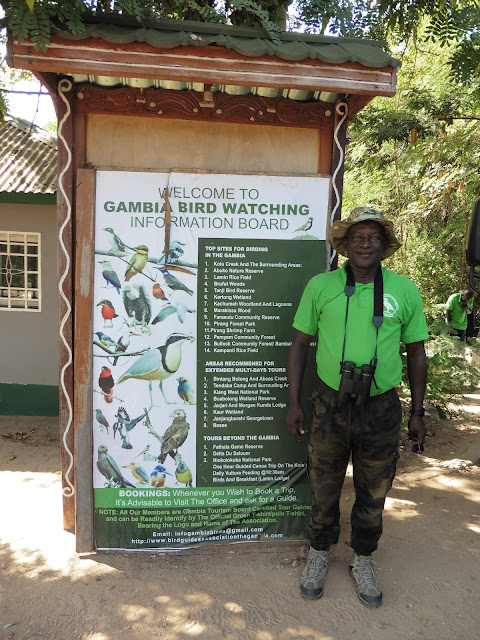
Gambia Bird Watching Society at Kotu Creek.

On our first full day in The Gambia, we went to Kotu Creek. Here we met several enthusiastic members of the Gambia Bird Watchers’ Association. We heard about their work, particularly to protect and expand the mangroves of Kotu Creek. They were enthusiastic, articulate and inspiring, and very grateful for the support from our leader, Simon Tonkin, and through Honeyguide for their work. We saw mangroves planted and now growing well thanks to money sent from the previous Honeyguide group in 2018. These mangroves are valuable as a wildlife habitat, as a defence against erosion and are powerful carbon sinks – it’s said that they can store up to 10 times more carbon than forests.
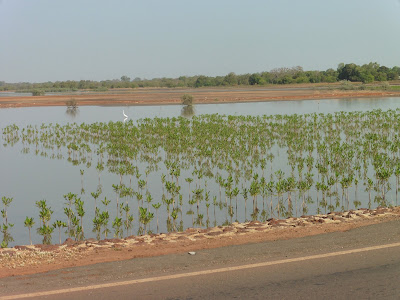
Newly planted mangroves, upriver in The Gambia.
On 8 December, we visited Farasutu Forest. This is a community nature reserve (as it says on the polo shirt I bought there), an isolated patch of forest run as a haven for wildlife by a dedicated team of bird guides. We – and other visitors – paid for our visit and this is how it continues to be protected.
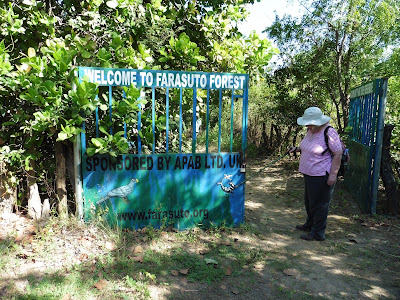
'Welcome to Farasuto Forest'.

While based in Georgetown (Janjanbureh), we took a boat trip to Kunkilling Community Forest Reserve. This riverine forest by the Gambia river is known for Adamawa turtle dove, a very scarce species only discovered in The Gambia in 1990. A warden joined us and took us down the main track before we went into the wood, following the dove’s call – a purring like a low pitch turtle dove. We found it and had excellent views – possibly the best views that the warden had ever had, from the joy on his face when using our telescopes (a piece of kit he lacked). Again, we paid for the boat and the visit – all part of the process to continue protection.
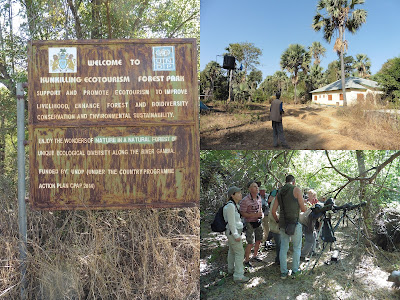
Kunkilling Ecotourism Forest Park: welcome sign, arrival area, watching an Adamawa turtle dove.

All these places, and others, survive by having visitors like us visit them. For us this was exploration as it should be, I think: we met people and engaged with them. Green tourism at its best.

That begs the question: what is ‘green tourism’ (also called ecotourism)? Greening is generally seen as a process rather than a precise end-point.

Coming up with a precise definition is tricky and it’s probably hard to improve on what Wikipedia says: ‘Ecotourism is a form of tourism involving responsible travel (using sustainable transport) to natural areas, conserving the environment, and improving the well-being of the local people.’ The ‘sustainable transport’ element is a moot point, of course.

For Honeyguide, examples of green tourism in practice include using locally-owned accommodation where possible, promoting understanding of wildlife and conservation issues and, especially, the conservation contribution included with every holiday. This has been at the heart of what Honeyguide does since we started more than 30 years ago.

Flights bought by Honeyguide are tiny in number and carbon footprint in the scheme of things. But we must acknowledge that the travel industry does, overall, have a big carbon footprint, especially from flights. Travel is not the only culprit: for example, the global fashion industry also has a massive carbon footprint. I hope it’s a compliment to say that a quick glance at a group of Honeyguiders suggests that we are well detached from the excesses of high street fashion!

Finding solutions is not easy. For us, buying the very best carbon offsets helps, of course. Running UK-based holidays without flights proved possible during the two years affected by Covid-19 lockdowns. Doing the same for overseas holidays is more challenging, often near-impossible. For wider policy issues, Friends of the Earth (here) summarises the issues.

What we do is not perfect. Put on a spectrum of travel ‘green-ness’, it’s certainly better than a lot of international travel. (Name your own examples … flying overseas to drink too much on stag/hen parties is one that comes to mind.)

My perspective is that we should continue to use travel as a force for good: protecting ecosystems, fostering understanding, encouraging sustainable practices, travelling as responsibly as we practically can.

Chris Durdin

Saturday, 20 August 2022

Thorpe Marshes with Hickling Broad U3A group, 18 August 2022.

This account is by Chris Foster, who arranged a visit to NWT Thorpe Marshes for the University of the Third Age (U3A) Hickling Broad group. This is for their monthly newsletter and shared here as a guest blog.

This month we had a guided walk around Thorpe Marshes with the brilliant and enthusiastic Chris Durdin as our leader.  Chris has intimate knowledge of this recently evolving reserve (established in 2011) and he visits so frequently he knows which leaf to turn over to reveal a rare bee or a mating damselfly.  He can hear a bird, identify it and locate it in his telescope before you have even established which tree it is in. His knowledge extends to all things wild. On our visit in August it was the plants that were the main headliners and the variety of marsh plants was dazzling. 

Bee wolf on angelica.

Personally I was especially interested in how the enthusiastic naturalists of Norfolk are recording the changes in species as a result of climate change.  Chris and others who explore the marshes have been the first to record some continental species that are spreading into the county.  One example of this was spotting the bee wolf (a wasp) which is new to Thorpe Marshes.  These meticulous records that have been and are being collected by specialists and local experts once again illustrated the impacts of climate change on the natural environment.  They also offer undisputed evidence of these changes. 

Migrant hawker.

Chris keeps a constant record of all the happenings at Thorpe Marshes so if you are interested in his work or want to see some great photographs, need tips on what to look for (most of the plants etc. can be found in and around Hickling) or are thinking of a visit, do click on the link above.  Entrance to the marshes is free and Chris offers monthly wildlife walks booked through NWT which I would highly recommend. 

We also saw four migrant hawkers hanging from a willow, a black-tailed skimmer, red-eyed damselflies, mating common blue damselflies, banded demoiselle, also red bartsia bees were still present.  Birds included whitethroat, chiffchaff, robin in autumn song, great spotted woodpecker, long-tailed tits, juvenile stonechat, cormorant and buzzards.

Monday, 18 July 2022

Holkham guided walk, 15 July 2022

A select group of four Honeyguiders met at Lady Anne’s Drive on the Holkham estate on a warm and sunny July morning. Our target for the day was creeping lady's tresses, a diminutive white orchid which is scarce but widespread in the native pine forests of Scotland but with an odd out-lying population at Holkham in the pine woodlands that were planted to stabilise the sand dunes in the 19th century. The origin of the Holkham population is uncertain - some think they might have been inadvertently introduced on trees planted in the dunes that had been grown further north. We will never know for sure.

'Gatekeeper among thousands' (Jillian Macready).
Walking out along the track running westwards behind the pines, it was obvious that it was peak emergence time for gatekeeper butterflies - they were everywhere. Also on the wing were speckled wood, green-veined whites, large and small skippers, peacock and red admiral.

 Hoverfly Eristalis pertinax (Rob Lucking).
Several great pied hoverflies Volucella pellucens hovered in front of us, occasionally landing – once on Malcolm’s hat! – and allowing to see its glossy black thorax and abdomen with a white stripe between the two. There were other hoverflies out as well but the only one we could identify from photos was Eristalis pertinax. There were also several large robberflies - possibly hornet robberfly judging by their size.

Robber fly sp (RL).
By Meals House we looked in the old cart barn for evidence of ant lions and found several of their shallow, conical pits. Helen did her best to entice some of the larvae out but to no avail. Maybe they had already flown.

Ant-lion pits among the brickwork (JM).

As we neared the end of the pine woods, we cut through towards the beach to the area of dunes where the creeping lady's tresses are found. Some forestry work had been carried out along the track and the more open areas had quite a lot of ragwort growing which in turn held caterpillars of the cinnabar moth. We also found several plants of lesser centaury. As the woodland opened out onto the dunes, we found that the creeping lady's tresses area had been roped off and within it we found at least eight spikes - some tightly closed and the others fully open.

Creeping lady's tresses (JM).

Megachile leachella, male on fleabane (JM).

Two bees photographed by Jillian, with IDs confirmed later, are of note. Silvery leafcutter bee, Megachile leachella, is the UK’s smallest leafcutter bee; the green tinge to the eyes is a feature. The BWARS website shows a coastal distribution for this species.

Heriades truncorum, female, also on fleabane (JM).

Heriades truncorum is also scarce (see BWARS website), though spreading, and is often - though not always - associated with pines, using resin to build partitions of its nest, liking dead timber with suitable-sized beetle holes, in the sun and with yellow composites, often ragwort but today fleabane.

At this point Jillian departed for Warham Camp and the rest of the group had lunch looking out over the beach. It was the section of beach frequented by naturists so we didn’t look too closely!

After lunch we walked west through the dune slacks looking for a butterfly speciality – the dark green fritillary. It didn’t take Helen long to find the first one - a rather worn specimen but it did at least sit still for long enough for us to give it good grilling and we even saw the dark green underwing for which it is named.

Holkham collage. Clockwise from top left: Six-spot burnet moth on willowherb; emperor dragonfly devouring the soft parts of a peacock butterfly which it had just caught on the wing (somehow it sucked the innards out, which were egg-yolk yellow); creeping lady's tresses, cinnabar moth caterpillars (we must have seen hundreds, they were on every ragwort plant) (Helen Crowder). 

As we wandered through the dunes, we found several more dark green fritillaries and also watched an emperor dragonfly catch a peacock butterfly in flight and take it down to the ground to eat.

The dunes themselves were very parched but we did find some common centaury and lots of haresfoot clover.

Common centaury (JM).

We retraced our steps back towards the car park. There were a lot of very fresh and brightly coloured ruddy darters sunning themselves on the track. We also found a couple of new butterflies for the day – brown argus and small copper. We stopped and lingered next to a stand of elms which have proved good in the past for white-letter hairstreak but it was getting a bit late in the day; the breeze had picked up and we drew a blank. A large, pale brown insect flew past quickly and did several circuits – not a butterfly but an oak eggar moth!

Jillian reported a successful visit to Warham Camp where she had seen chalkhill blue butterflies which added to the 15 species we recorded at Holkham gives us a very respectable 16 species overall! 

Chalkhill blues at Warham Camp (photos by JM).

Rob Lucking

Malcolm Crowder 1933 – 2026

Malcolm Crowder, Honeyguider and trustee of the Honeyguide Wildlife Charitable Trust, died on 19 July. His death, aged 92, followed a time o...