Tuesday, 24 August 2021

Southrepps Common and Pigneys Wood, 23 August 2021

Two new sites for Honeyguide days out today, the first thanks to our guide for the morning, former Southrepps resident Helen Crowder. For an August morning it was decidedly chilly, in case anyone reading this blog wonders why there is no mention of invertebrates this morning.

Angelica, Southrepps Common.
For a wet site, it couldn’t be easier, as a boardwalk runs right through Southrepps Common, now a nature reserve managed by Norfolk Wildlife Trust. The first stretch was dominated by reed, though with many fine umbels of angelica by the boardwalk. The floristically rich area was a little farther along, where it was more open and, on the far side, recently cut as part of the site’s management. We found lots of marsh lousewort, also called red rattle, sometimes alongside yellow rattle, the latter in flower and in seed, the two rattles a combination you don’t often see. There were dozens of spikes of marsh helleborines, seed heads this late in the year, plus eyebright.

Eyebright.
Marsh helleborine, in seed (Jillian Macready).

Marsh lousewort (Jillian Macready). 

There was a good reason for the timing of the visit: it was perfect for seeing the gorgeous grass-of-Parnassus, which is scarce and local in the southern half of England, albeit more widespread farther north. These were both in flower and in bud, and with distinctive leaves wrapped around their stems. Though once classified with saxifrages they are now on their own, taxonomically. The reason for the name, most sources say, is that cattle on Mount Parnassus liked them so much that they count as an honorary grass.

Grass-of-Parnassus.


Southrepps Common.

Beyond the common, Helen led us through a woodland of Scots pine, sweet chestnut and bracken. This brought us to an attractive property with various bird boxes and a lovely garden, and a large open outbuilding which where a dozen or so swallows were perching, mostly over a tarpaulin presumably carefully placed to keep their droppings away from a vehicle. Sheep here were the breed Kerry Hill, Helen says. Then alongside the path there was a long strip sown with an arable wild flower mix: corn marigold, cornflower, musk mallow, haresfoot clover, wild carrot and seedheads of corn cockle. Three of us stopped to look at a moth on ivy: straw dot was the conclusion.

Arable wild flower mix.

Straw dot moth ((Jillian Macready)
We continued through farmland, with pigs on our right and wheat on our left. Among the pigs were gulls, rooks, jackdaws and red-legged partridges. By the wheat was a selection of unsown flowers that like arable land: heartsease, scarlet pimpernel, bugloss, redshank and others. Back where we’d parked, we took a few steps back to see a great spotted woodpecker on a dead tree.

Tim and Cheryl led a careful convoy to the car park for our afternoon walk at Pigneys Wood. At last we had some sunshine, ideal for eating picnic lunches and bringing out some butterflies including a speckled wood in the car park and a painted lady on a buddleia near the information board. We looked at yellowy-green galls on alder leaves, caused by a mite Acalitus brevitarus.

Small tortoiseshell, Pigney's Wood (Jillian Macready).
The wood itself was planted by the North Norfolk Community Woodland Trust, entrusted to Norfolk Wildlife Trust to manage in 2017. Inevitably the new woodland isn’t the most interesting for wildlife, though wet areas, a small heathland and meadows make it all an attractive mosaic. We walked along a wide ride, though a short stretch of wood and meadow and emerged into an open area. Here a southern hawker was hunting, stopping to perch and hang vertically in their characteristic style. With a little patient observation, we realised there was both a male and a female southern hawker doing this.
Southern hawker, male (Jillian Macready).
Brown hawkers, their amber wings obvious in flight, and a migrant hawker added to the mix, as did common darters. In this meadow area we mostly looked at wild flower ID, such as common hemp-nettle and the difference between a trio of peas, greater birdsfoot trefoil, meadow vetchling and tufted vetch. We were soon alongside a vegetated stretch of the North Walsham & Dilham Canal, with reedmace, branched bur-reed, water chickweed and water forget-me-not just a few of the wetland species noted. On the dry edge we looked at black medick and hop trefoil. A great spotted woodpecker settled on a dead tree. As we turned away from the canal, we passed a pond thick with water soldier where we paused to admire a ruddy darter and the white bells of greater bindweed, completing a set of three bindweed species today.

Dark bush cricket, female (Jillian Macready).
We wiggled through a dark and damp stretch of old hazel coppice and headed up a gentle slope. Here we found a dark bush-cricket on some stinging nettles. Jillian photographed and a harvestman: a tentative ID is noted – any better ideas?

Harvestman, Pigneys Wood (Jillian Macready). Tentative ID: Leiobunum rotundum (e.g. here).
This route led to a small patch of heathland creation, with heather and bell heather. Ann was identifying various bees, mostly red-tailed and common carder bees.  Jillian’s interest and growing expertise in hoverflies is shown in the photos below.

Long hoverfly Sphaerophoria scripta on heather (Jillian Macready). 

Marmalade hoverfly Eipsyrphus balteaus (Jillian Macready).

Only very low-growing gorse was in flower and a careful sniff revealed a lack of almond scent, suggesting it was western gorse, also found on other east Norfolk heaths. Narrower flowers and a ‘harder’ yellow colour add weight to this ID. By now the warmth had brought out lots of gatekeeper butterflies.

Western gorse in the heathland creation at Pigneys Wood.

Chris Durdin

Thursday, 19 August 2021

Two days in North Norfolk, 17 & 18 August 2021

Chris Durdin joined long-time Honeyguiders Sue & Peter Burge and Helen & Malcolm Crowder for two days out in north Norfolk. They were staying at The Pheasant Hotel in Kelling.

17 August – Blakeney Harbour and Holt Country Park

Where was the late August heatwave that was once forecast? On a wet morning, with a boat trip booked for noon, we started by driving to the beach at Salthouse, then a brief stop to overlook Cley Marshes from NWT’s visitor centre. Here, from a fairly sheltered spot, a volunteer guide had his telescope on a pink-footed goose, a very early arrival for the winter. There was also a good number of black-tailed godwits, an avocet and a marsh harrier.

Mostly harbour seals; the blotchy one is a grey seal.

After a short detour to see Blakeney Quay we arrived at Morston in good time for the Blakeney Harbour seal trip. A surprise was seeing spoonbills flying around, firstly a group of four then singles in various directions. Once in the harbour there were curlews, little egrets and oystercatchers and an interesting range of boats described by the Beans Boats guides.

Out on the edge of Blakeney Point there were summering eider ducks, two of them, just before we reached the main group of seals, today mostly common (harbour) seals, mixed with some Atlantic grey seals. Banter from the guides include seal names: Ron (Ronseal) and a daft one called Imba seal (think about it).

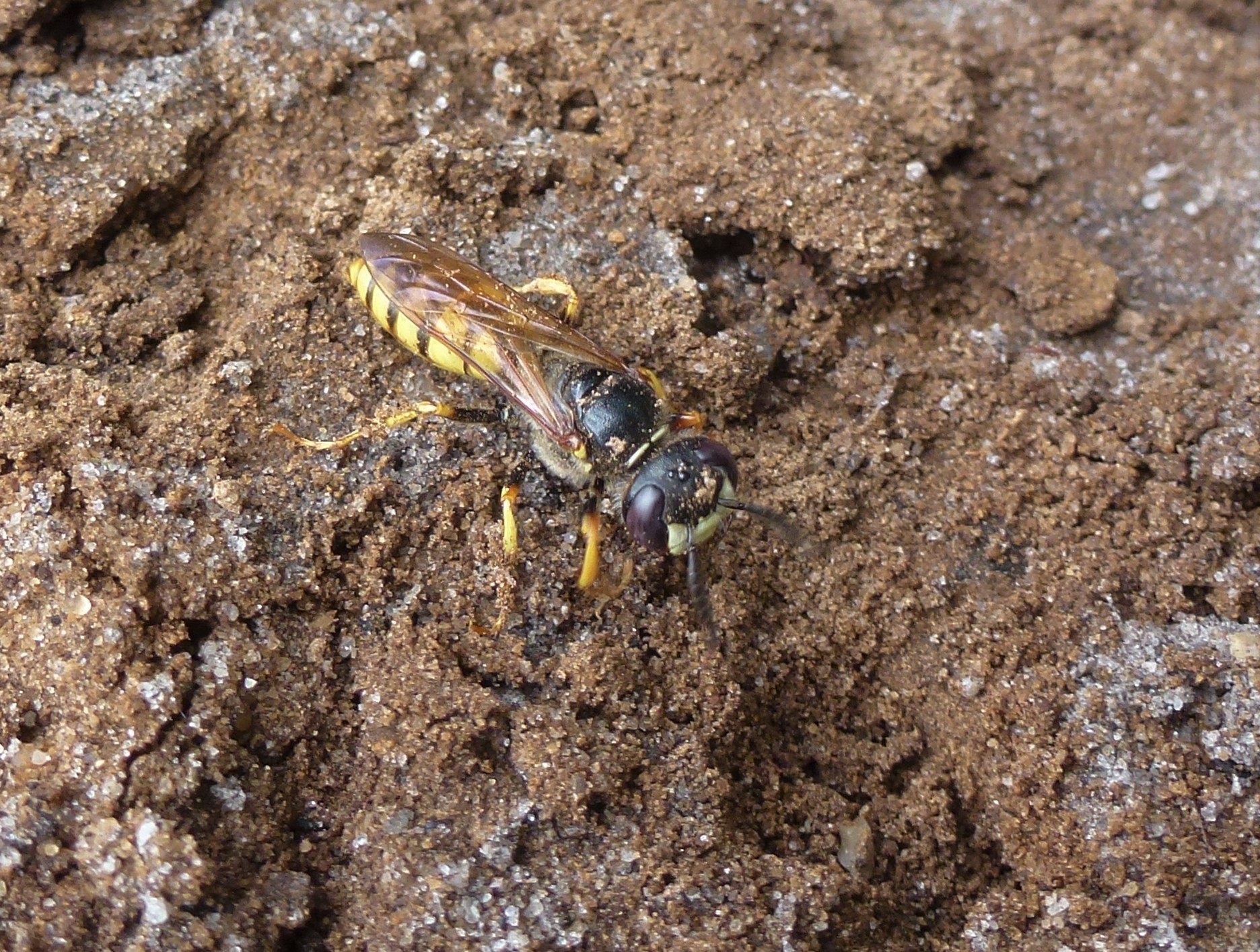
We had lunch at Holt Country Park. The rain had stopped but it was still grey, so no butterflies on the buddleias. Once on the heath we stopped where there were bee wolf holes and, to our surprise, one showed and did some excavating. (More about this impressive solitary wasp here.)

Bee wolf.
We carried on around the edge of Holt Lowes SSSI. It was too grey for any keeled skimmers to be on the wing though characteristic flowers included marsh lousewort, three heather species and, in the final boggy patch, a fine show of round-leaved sundews.
Round-leaved sundew, Holt Lowes (photographed on a sunnier day).

We then moved onto Plumstead for a tour of John Durdin’s garden.

18 August – Wells, Warham Camp and Kelling Water Meadows

We parked near the Co-op and walked to East Quay, pausing for a lively flock of house sparrows in shrubby sea-blite bushes. The tide was out and the saltmarsh was colourful with sea lavender. Twice spoonbills flew past then disappeared from view into deep creeks.

The main lagoon at North Point pools at the eastern end had lots of water; next to it the seasonal flood had gone, the usual routine here with winter wetlands drying out for summer grazing. It was Helen who saw the crane in the large flock of greylags. For such a big bird it had a knack of disappearing from view, either behind tall rushes or in hollows.

Crane at Wells, with greylags (digiscoped).

The lagoon had a nice selection of waders: black-tailed godwits, avocet, ruffs, redshanks, lapwing and ringed plovers. A group of golden plovers flew around before settling and, in its usual way, we heard the ‘choo, choo, choo’ of a greenshank before it flew past. One of the spoonbills was in view on the way back to Wells.

Warham Camp.

We ate by the roadside at Warham before walking to the iron age fort. The chalk grassland here was a sea of wild flowers: small scabious, burnet saxifrage, stemless and carline thistles, squinancywort and thyme. We quickly saw our first chalkhill blue butterfly and, as the afternoon warmed, scores were on the move. Small skippers and painted ladies were among the other butterflies.

Chalkhill blue butterfly, male.

Female chalkhill blue (nearest), male below, on autumn gentian.

Autumn gentians were nice to find as we carried on our walk around the fort. A red-breasted carrion beetle earns a mention; Sue found a banded demoiselle not so far from the river at the bottom end of the circuit. Patches of yellow flowers here were wild parsnip; on the way in they’d been ragwort, surprisingly lacking in cinnabar moth caterpillars. A wall brown butterfly was a nice find.

Wall brown.

Stemless thistle.

Red-breasted carrion beetle Oiceoptoma thoracicum.

We returned to The Pheasant, then did the local walk to Kelling Water Meadows. A pair of birds on a hedge top included the brightest red cock linnet I’ve seen in a long time. The ducks on the lagoon at Kelling Quags were all gadwalls, in moult, with a couple of black-tailed godwits. At last, some proper sunshine as we reached and sat on the beach. The sea was calm but there were still birds on the move: curlews, oystercatchers, common and Sandwich terns.

Chris Durdin 

Thompson Common guided walk, 14 August 2021

This was a joint event between Honeyguide and RSPB Norwich Local Group. This report is by Doug Arkell.

Including Chris Durdin and myself, a party of sixteen assembled for what was, for most of us, a first visit to Thompson Common. Although signage was poor, we all managed to find the car park and arrive in good time. 

Thompson is the ‘local patch’ of recently joined member Phil Childs. He has known the reserve for many years and was good enough to offer to show us around. Luckily there were also several butterfly and dragonfly experts in the party, as the visit was heavily weighted towards those taxa.

Dusky sallow moth on black knapweed.
Our first sighting came in the car park with a white admiral butterfly briefly descending and settling on one of the cars. We joined the path onto the common through a mature wooded area. The brambles were in flower and attracting butterflies including peacock, red admiral, speckled wood and two very tatty silver-washed fritillaries. High in an ash tree several purple hairstreaks were spotted. Though difficult to find among the foliage, Chris Durdin managed to line one up in the scope for us.  A dusky sallow moth was photographed on a knapweed flower.

The path through the reserve forms part of the ‘Pingo Trail’ and we soon came upon some of these features. Forming round depressions with raised edges they provide an aquatic habitat for many species of plants and animals. They appeared to vary in both diameter, depth and in their vegetation. Phil gave us a brief explanation of their glacial origins. As we progressed along the path we came across a small herd of longhorn cattle, which included several cows with calves and a large though very passive bull. These animals, along with Konik ponies, which we did not see, are used to graze the common to maintain the open habitat.

Ruddy darter (left) and common darter (right) [Stephen Spouncer].

From the time we first left the car park we began to see different Odonata (dragonfly and damselfly) species. A few of these insects were attracted to some members of our party and settled on shoulders, hats and hands providing photo opportunities. Male ruddy darter and female common darter on Chris’s hand and Tessa’s hat respectively made an excellent shot. Further along the track we were surprised to see a female southern hawker dragonfly laying eggs directly into a fallen log several metres from the nearest water. Common darters were also seen releasing eggs well away from standing water. It would be interesting to discover the reasons for these behaviours and to find out whether the eggs had any chance of hatching.

Southern hawker egg-laying.

Willow emerald and scarce emerald damselflies are among the several species to have colonised or re-colonised Norfolk over the last 30 years or so. We were lucky enough to see both of these. An example of the former was spotted resting on a dead ash twig a couple of metres above us. There were scores of examples of the ‘scarce’ (not so scarce here) including many laying females and mating pairs. Common blue damselflies, brown hawkers and emperor dragonflies were also prolific.

Pair of scarce emerald damselflies (Doug Arkell).

On our way back to the car park for lunch, we saw brimstone butterflies and Regine disturbed a probable pool frog, a specialty of Thompson.

After lunch myself, Ally, and Chris Durdin followed Phil Childs by car to the other side of the reserve and Thompson Water. Phil explained something of its origins as a man-made feature and more about NWT’s management of recently acquired additional land. There were mute swans, mallards, coots and an immature great crested grebe on the water and we heard chiffchaff, wren and long-tailed tit in the bushes near the banks. Red-eyed damselflies rested on duckweed in the shallows.

Looking at the reserve plan it was obvious that the group had only covered small part of Thompson, so there is much more to see here. More photos here.

Doug Arkell

Monday, 26 July 2021

Warham Camp & Stiffkey Fen, 21 July 2021

Five Honeyguiders met up on a gloriously sunny day on a minor road just south of the village of Warham to visit Warham Camp, an Iron Age hill fort and one of North Norfolk’s most important chalk grassland sites. While we waited for the group to assemble we explored the road verges and found some nice stands of agrimony and a six-spot burnet moth nectaring on a scabious flower.

Six-spot burnet moth on scabious.

We walked a short distance up the road before turning off on the track down to the camp. The tall hedges were alive with insects including a rosy footman moth. We also spotted many galls on dog rose - some were clearly robin’s pin cushions, caused by the wasp Diplolepsis rosae while others were small, smooth pea-shaped galls. We assumed the latter were young galls of the former but research back at home revealed that they were actually smooth rose pea galls caused by the wasps Diplolepis nervosa or Diplolepis eglanteriae.

Smooth rose pea galls.
As we walked onto the outer bank of the fort we saw our first chalkhill blue butterflies. The colony at Warham is the northernmost in the UK and is thought to be the result of an illicit introduction some years ago. In total we saw around 40 - all males - some of which posed nicely for photographs. The fort was also alive with six-spot burnet moths, small skippers and ringlets.

Chalkhill blue.

The chalk grassland flora was at its prime with chalk grassland specialities such as stemless thistle, common rockrose, small scabious, squinancywort, dropwort, harebell, restharrow and hoary plantain all in flower on the chalk banks. A few pyramidal and common spotted orchids were still in flower but most were past their best. In the damper, central area was wild parsnip, cow parsley and meadowsweet.

Stemless thistle.

We ate our packed lunches back at the cars under the shade of an oak tree before travelling the short distance to Stiffkey Fen, a freshwater lagoon fringed with reed created from a former arable field by the late Aubrey Buxton in the mid 1990s.

As we walked along the Stiffkey River we saw male and female banded demoiselles, a patch of yellow Mimulus guttatus or monkeyflower, a nice sized brown trout and we heard some newly fledged marsh harriers. Once on the sea bank, the heat haze made viewing of the fen challenging but we did pick out a small flock of black-tailed godwits, still in their red breeding plumage, and six greenshanks. Around a dozen spoonbills loafed on the lagoon and a little egret fed in a saltmarsh creek.

Spoonbill.

We continued walking along the sea bank to look out over Blakeney Harbour. We could see common seals right on the end of Blakeney Point and white haze of breeding terns. Closer in among a small flock of black-headed gulls was a single summer plumage Mediterranean gull. A fritillary butterfly - most probably dark green fritillary - flew past but didn’t stop and disappeared into a thick bank of gorse.

We walked slowly back to the cars seeing a pair of bullfinches and a red kite feeding over a nearby arable field. 

Rob Lucking

Friday, 9 July 2021

Foxley Wood and Sculthorpe Moor, 9 July 2021

After several rainy days it was a relief to arrive at NWT’s Foxley Wood nature reserve, albeit after a detour via Themelthorpe, on a dry day with sunny intervals. The local butterflies must have been grateful for the improved weather: our first ringlets were in the car park and I glimpsed a white admiral flying away.

Ringlet, by far the most numerous butterfly today.

Six of us walked into the wood, where wide rides meant lots of flowers, including hundreds of common spotted orchids, and a steady string of butterfly sightings, with large skipper, large white, comma and meadow brown along these first stretches, though it was still ringlets that by far outnumbered all of these.

Common spotted orchids, Foxley.

At the main crossroads, a choice: towards where people were waiting around some tall oaks, or turn right along a wide and sunny ride. We chose the latter, taking advantage of the good weather at this point. It was a good choice as along here we soon found a lovely, freshly-emerged white admiral feeding around a patch of bramble flowers. We had excellent views through binoculars, though it proved too distant to photograph as did several others during the morning.

Silver-washed fritillary.

There was also a faded painted lady here and then a silver-washed fritillary flew by. This fritillary, then others later, were mostly on the move though one did settle long enough for good views and a photo, as did a common darter.

Honeysuckle leaf with mine of leaf miner Chromatomyia lonicerae.

Also along this ride was another dragonfly, a very fresh brown hawker that could be picked out hanging among some dead, brown leaves. We’d already seen a superb six-spot burnet moth on a marsh thistle, then Ann found another that had just emerged from its chrysalis. A cluster of hogweed flowers had a longhorn beetle, red soldier beetles and thick-legged flower beetles. There were hundreds of black, spiky peacock butterfly caterpillars on stinging nettles.

Six-spot burnet moth emerging from its chrysalis.

We continued around the wood, muddy in places on some paths, with patches of creeping jenny and a lot of enchanter’s nightshade in flower. By one track a purple hairstreak caught my eye, almost on the ground; we all saw it very well. Birch polypores and King Alfred’s cakes fungi were on birch and ash respectively.

King Alfred's cakes.

Towards the end of the circuit we reached the big oak trees and learnt from those watching here that there were no sighting of purple emperors as yet, here where they were seen last year. There were, however, more white admirals, red admirals and silver-washed fritillary again. Small white was an additional butterfly species after this.

Lovely wide rides in Foxley Wood.

Saying farewell at the car park to Tim & Cheryl, who were just with us for the morning, we learnt the hard way that the road through Foxley village had not been reopened. We returned via Themelthorpe and onto Foulsham before finding the main Fakenham road and onto Sculthorpe Moor, a route that included a patch on the edge of Fakenham where it had evidently rained.

Honeyguider Helen Young was waiting for us here at the Hawk & Owl Trust’s nature reserve, where we took advantage of the picnic tables to eat our packed lunches, while watching greenfinches on the huge feeders. New paths and habitats had been created since I last visited, near the reserve’s visitor centre, and Helen guided us through these. Ann noticed a dragonfly struggling in a new pond, and she rescued it and left it to dry out on a wooden post. It was still there at the end if the afternoon, suggesting that it had emerged with damaged wings.

Rescued common darter, though we think it had damaged wings.
Again there were lots of ringlets, a large skipper on a marsh thistle and wide ditches had banded demoiselles. Generally, the weather became greyer and there was little to see from the boardwalks in the wooded section of the nature reserve. Farther on, after Helen had left us to meet her lift home, there was more activity from birds, especially towards to the end of the afternoon, with singing reed bunting and reed warblers and sightings of whitethroat, sedge warbler and great spotted woodpecker. We also heard a grasshopper warbler and saw our first speckled wood of the day. Globular galls on alder leaves were caused by a mite, Eriophyles laevis. On the ground we found a scorpion fly, which takes some beating as a weird and wonderful insect.
Large skipper, Sculthorpe.

Scorpion fly Panorpa communis.

A red kite flew over and, once we were back in the car park, it returned to fly low over the area behind the visitor centre.

A contribution towards the Hawk & Owl Trust was included for the today's group. matched by a contribution from the Honeyguide Charitable Trust, raising £120 for Sculthorpe Moor.

Chris Durdin

Tuesday, 6 July 2021

Honeyguide blogs to stop arriving by email

Honeyguide blogs will stop arriving by email during July 2021. The 'Honeyguide blogspot' is set up on Blogger, which is run by Google. The system is now showing an  announcement that "automated emails to your subscribers will no longer be supported." The timescale given is July, though without an exact date.

While there is a facility to extract the emails of the those who have subscribed, we think that a more practical way to be alerted to a new blog is by following Honeyguide’s Facebook page, where blogs get posted. Apart from this one, which is too dull! Blogs are also listed on the Honeyguide news page.

We appreciate that Facebook and other social media are not everyone's cup of tea and we've all read criticism of Facebook and other tech giants. My perspective is that a lot of this is down to users. It's not perfect but we find Facebook is a practical way to share wildlife photos, blogs and other updates. The Honeyguide e-newsletter will continue as now.

In the meantime, writing this short blog is the easy way to explain about this change.

Chris Durdin


Saturday, 3 July 2021

Buxton Heath and Holt Lowes, 2 July 2021

The day started well when Honeyguider Ann Greenizan arrived at mine and found caterpillars of toadflax brocade moth on purple toadflax in my front garden. But we were still in good time for today’s morning at Buxton Heath which was, initially, in overcast weather. Usually you’d hope for sunshine to find the heath’s star butterfly, silver-studded blue, but after four wet days they were evidently keen to be out and we found them immediately on low-growing bell heather close to the car park. Better still, the conditions meant they were moving slowly, allowing for close views and photographs. As the weather brightened we found many more, both here and on the western side of the heath, and in places there seemed to be scores on the wing.

Silver-studded blue, male.

Silver-studded blues, mating pair, on bell heather. The silver 'studs' are best seen on the browner female.

We moved towards the boggy area in search of plants, though firstly some birds deserve a mention. A yellowhammer, then two, on a wire; great spotted woodpeckers flying around and, especially, a woodlark in full song, at first a distant dot then quite hard on neck muscles as it soared overhead.

A slime mould on a log, probably Lycogala sp.
The orchids were the stars here, with various sizes, shapes and shades of pink. Common spotted, heath spotted, southern marsh and Pugsley’s march orchids all occur here, plus hybrids. The more I looked and, later, studied the book, the less clear-cut identifications seemed to be. Perhaps it doesn’t matter: the show was quite something. Marsh helleborine was certain, though. Here bell heather gave way to paler cross-leaved heath, sometimes in mounds among the sphagnum. Doug found a water avens and there were little clumps of bog pimpernel, some ragged robin and fen bedstraw.
Marsh helleborine.

We returned past the entrance to the heath and to a wet area, with lesser spearwort, fenced to prevent overgrazing. Here there were two female keeled skimmer dragonflies, an emperor dragonfly flew past, and Julia found the first common darter I’d seen this year. The local stonechats posed nicely, and Ann found a moth later identified as brown silver-lines. Back in the car park there was a painted lady on bramble flowers and green-eyed flies that were probably the horsefly called twin-lobed deerfly.

Brown silver-lines, larval food plant for which is bracken (Helen Crowder).

Twin-lobed deerfly.

We drove onto Holt Country Park and there ate picnics or food & drink from Hetty’s cabin. We took the path through the afforested area to the big pond at the edge of the heath where there were many large red and azure damselflies plus banded demoiselles and four-spotted chasers. We studied two moths on the underside of water lily leaves; one came closer and Helen photographed and ID’d it as the aquatic brown china-mark. We noted greater spearwort; the size difference compared with lesser spearwort was obvious.

Brown china-mark (Helen Crowder).

Moving onto Holt Lowes, we walked along the edge of the heath, coming across three red admirals that seemed to be feeding on sap on a gash on an oak tree. 

Red admiral, this one on gorse and low enough for a photo. 
Here we dropped down a little to skirt the wet edge, the path helpfully in the dry while overlooking the many boggy patches that make this place so special. The first had sheets of lesser spearwort and, as at Buxton Heath, keeled skimmers. We continued to see keeled skimmers in various wet areas all along here, including many powder-blue males.

Lesser spearwort.

At a small pond, we watched two broad-bodied chasers. The blue male was patrolling and the yellowish female was busy egg-laying, her abdomen repeatedly bent forward to touch the water. There were keeled skimmers again, then Ann noticed a large insect struggling on the water’s surface. She rescued it and the four-spotted chaser soon dried out on her hand, then on the perch where we left it.

Rescued four-spotted chaser.

A female brimstone butterfly was moving around a nondescript green bush, but for good reason as that bush was alder buckthorn, a larval foodplant for brimstones. With a little searching we found several tiny white eggs on the alder buckthorn’s fresh growth.

Brimstone eggs on alder buckthorn, Holt Lowes.

Julia and Helen were at the front of the group as the path weaved through some tall gorse and they called us to a halt to see a slow-worm, which helpfully stayed still, presumably hoping we hadn’t seen it. Remarkably, soon after there was a second slow-worm. Another star finding on a bare path was a green tiger beetle. It seemed to be hunting ants.

Slow-worm.

Common spotted orchid, marsh helleborine (as at Buxton Heath) and marsh lousewort were among the flowers in wet areas and it would be only fair to mention the wonderful show of foxgloves on the dry heath, as well as lots of bell heather. Finally, on the last boggy bit, we found one of the botanical stars of Holt Lowes: round-leaved sundews.

Round-leaved sundew.
Chris Durdin

Malcolm Crowder 1933 – 2026

Malcolm Crowder, Honeyguider and trustee of the Honeyguide Wildlife Charitable Trust, died on 19 July. His death, aged 92, followed a time o...